Your cart is empty.
Return to shop
Adapted to a place. Not to fads or tastes.
Nothing here is embellished – and certainly not intended. The Honigberg simply is. And wants to be nothing else. So simple – and yet so difficult.
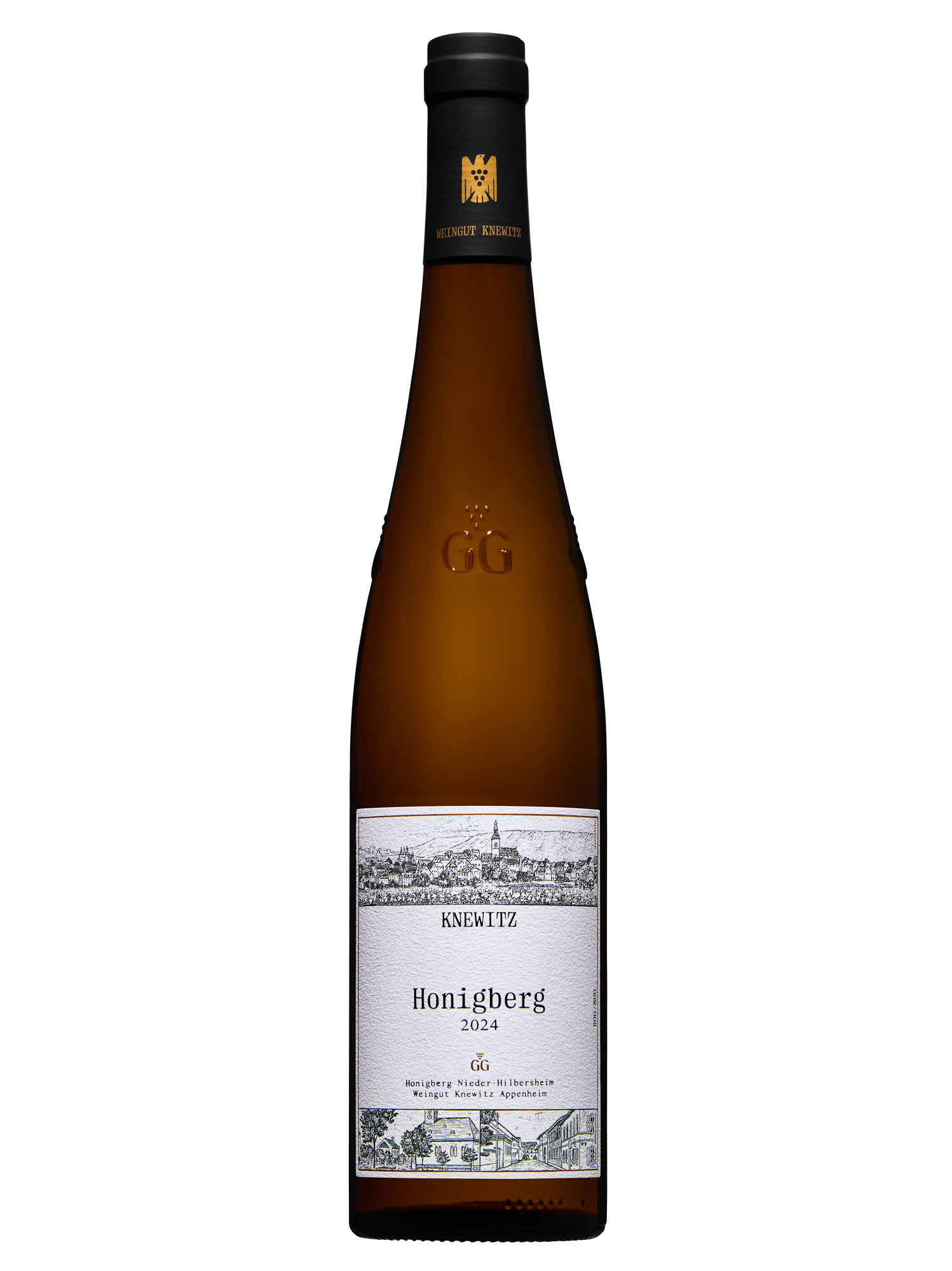
Mentioned in documents since 1740. Family-owned for six generations. Back then, it was the so-called Hunnic grape varieties that took root here – today it is Riesling. Much lies hidden here between the rows, between the layers of ancient rock, between the years.
Vieles liegt hier zwischen den Zeilen, zwischen den Gesteinsschichten, zwischen den Jahren.
A special place making us look back on our own history with humility and reverence. An amphitheater opening to the southwest, offering a view far into the valley.
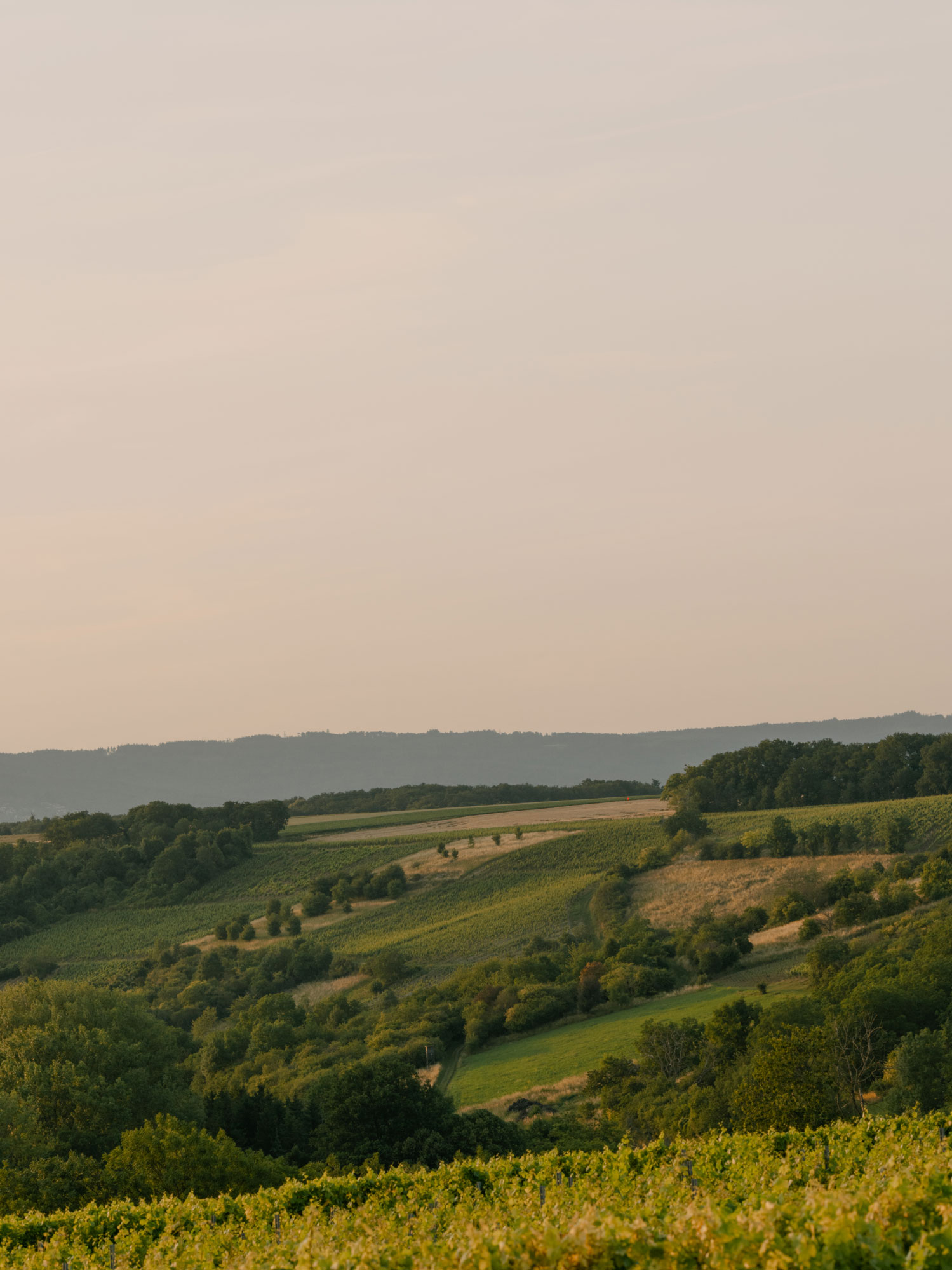
Sheltered from the wind, quiet and profound, the Honigberg lies between the Appenheimer Hundertgulden and the Nieder-Hilbersheimer Steinacker sites. 1.61 hectares of Riesling, on a slope with a 30 to 50% incline and altitudes of 190 to 240 meters.
The Honigberg is a solitaire that encompasses plurality: At the bottom, 40-million-year-old limestone dominates, interspersed with clay and chalk. Further up, there are iron-rich tropical soils and ironstone – a treasure that was formed 15 million years ago in the primordial sea. Complexity that, along with an exceptional microclimate, shapes the wines. The grapes are harvested when fully ripe and selected with utmost care. They are then gently pressed. The wine is fermented in traditional wooden barrels, spontaneously with natural yeasts.
No staging. Just time.
And attention.
Complex, long-lasting, rare – full of substance, tension and structure.
Wines with exotic fruit, salty length and savory spiciness.
The Honigberg is exactly what this place can be and wants to be. And it is completely itself at the same time.
It is origin.
And attitude.
You cannot invent identity. You simply have it. What fortune it is to be able to convey one’s identity in a wine.
SOIL DIVERSITY:
Different geological soil and rock layers visible within one vineyard
Lower part
Limestone (40 million years)
Upper part
Ironstone
(15 million years)
Lower part
Limestone
(40 million years)
CLIMATE ZONES
Upper red part very warm, amphitheater
Lower white part rather cool, slow ripening of the grapes, up to 5 days longer on the vine
am Stock
GENETICS
Older vines (2004) Alsace genetics, small bunches, intense aromas
Younger vines (2022) planting density 8,000 vines per hectare, massal selection from the old plot
2024 vintage
Harvested on October 17, 2024, with 93° Oe, 8.2‰ acidity and 3.10 pH value
Yield:
20 hl/ha
Fermentation:
Natural fermentation in
traditional 600-liter barrels (so-called Halbstückfass)
Fermentation period:
14 days,
fermentation temperature 22 to 25 °C
First sulphurization:
February 2025
Bottling:
June 25, 2025,
800 x 0.75l bottles,
30 x magnums,
6 x double magnums